“All that is mine I carry with me.”
Bias of Priene, leaving his home city, as Cicero tells it (Paradoxa Stoicorum I, 8)
On 3 October I wrote that Laya was taking over. That was a promise more than a fact. Laya answered every job-side question that Jev answered, but only in shadow. Jev still decided everything.
Today the picture is the other way round. Since 10 October, Laya decides which job ads enter Kitsuno and which ones pass the handshake gate. Since 13 October, it also scores jobs for every seeker it knows. In the last three days, Laya made 2,911 production decisions and Jev made 208.
If you are new here: Jev and Laya are not models that write. They are decision models. They read a text, such as a job ad, and answer closed questions about it with probabilities. Which country is this job in? Is it remote? Does it fit the role this person is looking for? They only choose between the answers we give them, so they are fast and cheap, and they cannot invent a sentence. Jev comes from TypeSafe in San Francisco, and its weights are closed. Laya comes from Nandakishor Mukkunnoth and ConvAI Innovations, and its weights are open. In Kitsuno, such a model stands at the door: it decides early and cheaply which jobs deserve the attention of the larger language models, and finally of the person.
This piece is about how we got there, what the failed rounds taught us, and why I think it was worth it.
Why replace a model that works
Jev works. It reads a text, answers closed questions with probabilities, writes nothing, and costs almost nothing at our volume. Per new job, it cut our language-model calls by about two thirds.
But Jev has closed weights and runs in the United States, and zero data retention is only for enterprise customers. We asked its maker about retention and privacy and have not had an answer. That collides with two of Kitsuno’s ten principles: the eighth, Open Standards, Not Walled Gardens, which says “open-source models for AI”, and the ninth, European by Design, which says “data stays in European data centers”. When I put Jev into production, I made the exception with open eyes and promised a way back.
The way back has three parts: an open model whose weights we hold, a place to run it where we know that our data is not kept and not used for training, and no single provider who can switch us off.
That last part is not theory. In June, access to two of the newest frontier models, Fable 5 and Mythos 5, was suspended for almost three weeks to comply with US export controls. Nobody who built on them had done anything wrong. The switch is not always a law. It can be an outage, a smaller quota, a region that is no longer served, or a price that goes up tenfold. If you can carry your model to another place, each of these is a bad week. If you cannot, you are stuck.
A teacher, never the incumbent
Laya has its weights open under Apache 2.0, so we can train it ourselves. We had to: out of the box it got 44 percent of our questions right. So the work was training.
One rule never changed: we never learn from the model we want to replace. Jev’s terms forbid it, and a student of Jev can at best become Jev. Jev’s answers were a comparison, never a label.
The labels came from a teacher: a model that reads each case with a written guide and answers the same questions. Our first teacher was a small open model on an old laptop. Laya learned from it and never got past it: both stayed below Jev. A better prompt for the teacher raised its score on the examples we tuned it on, and nowhere else. So we moved to a strong frontier model. Which one does not matter much; several labs have models that are strong enough, and we could change the teacher tomorrow. The teacher works only in training. It never sees a production request.
Training runs on a free Kaggle GPU. Since 2 October we have trained 24 versions of Laya there, each in under four hours, without renting a GPU. The first version took 39 hours on a laptop CPU.
The week the hill moved
Until 10 October, every job-side request went to both models. Jev decided; Laya’s answer was recorded. Production found what our test set could not, like Portuguese ads that Laya read as Brazil. One more training round fixed it.
Then came the week that taught me the most. We trained ten rounds in four days. Each round looked good on the days before, and failed on the next window of real traffic. It felt like walking towards a hill that moved back with every step.
The cause was simple once we saw it. A window of traffic belongs to whichever seekers are active. In one window, a single seeker profile carried more than half of all role questions, and none of its roles had ever been in training. Each round fixed last week’s seekers and did nothing for next week’s.
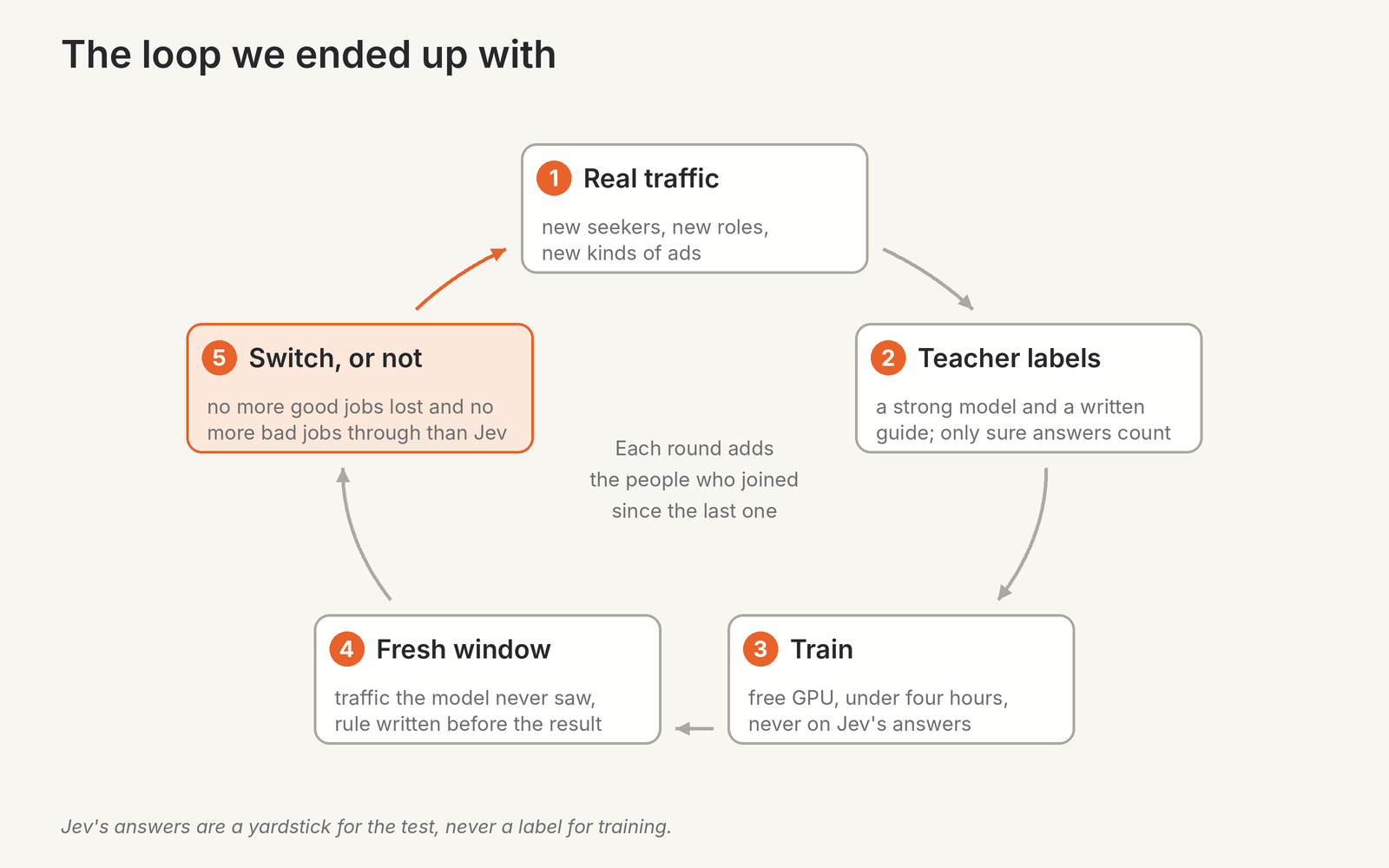
So we changed what we train on. When a new seeker arrives, the model now learns that person’s roles from their own crawl: a few hundred teacher labels per new role, the clear cases first, then the borderline ones. And every round includes the people who joined since the last one.
We also learned to write the go or no-go rule down before we look at a result. In the first rounds, we chose settings and test sets while we looked at the numbers. That is how you fool yourself. The rule we kept is simple: Laya may not lose more good jobs than Jev, and it may not let more bad jobs through. A good job counts as lost only when the teacher is sure it is good, because two careful readers disagree on about one job in seven.
By that rule, on traffic it had never seen, Laya lost as many sure good jobs as Jev (4 each) and let through 274 bad jobs where Jev let through 883. We switched the intake on 10 October. The handshake gate followed the same afternoon: there, Laya passed 19 bad jobs on to the expensive language-model check, and Jev passed 45.
Scoring is harder
The biggest Jev route left was the score: how well a job fits a person’s own record. The first test was a cold shower. Laya agreed with Jev in 17 percent of the cases, and where I checked by hand, Jev was right. The reason was almost embarrassing. Laya never read the job. Its input was too short, the record came first, and on a third of the cases not one word of the ad fitted in. It had also never seen a question about two texts at once.
We fixed the format, and the first new round looked half good: Laya lost 7 good jobs where Jev lost 28, but let 12 bad ones through where Jev let 1. Two more rounds with targeted labels brought the bad jobs down to 7. Still no-go.
Then we found the lesson of the week the hill moved again, one level deeper. Laya learns where “not this person’s work” ends and “a little of it” begins for each person, from that person’s own jobs. It does not carry that line to a record it has never seen. On intake, the unit was a role that many seekers share. In scoring, the unit is a person, and every person is different. Labelling every new seeker by hand would cost about a million teacher tokens per person.
What helped was breadth without real people. We had a frontier model write a few hundred synthetic seeker records in our exact format, with no real person in them. For the first time, the bad jobs dropped for seekers Laya had never seen. The last round added the real cases where Laya and Jev disagreed most, and synthetic records of generalists and career changers, where the line is hardest to draw. Every one of them was labelled twice, by two independent teacher passes.
That model passed the rule for every seeker it had training data for, and failed for one new seeker. So we did not switch everything. Since 13 October, Laya scores the 28 seekers it knows, on our own server. New seekers stay on Jev until enough of them have arrived for the next round. On the first day, Laya lost no sure good job and let no sure bad job through; Jev lost six and let one through. A small sample, and a good start.
What we learned
The training is the product. An open model gives you a place to start. The questions you teach it, the guide that explains them and the labels that answer them are yours, and they move with you.
Never learn from the model you want to replace. It is often forbidden, and it is always a ceiling. Jev was our yardstick, never our teacher.
The student stops where the teacher stops. A weak teacher gave us a weak model, and no prompt trick changed that. Spend on the teacher, not on the student.
Write the rule before the result. Every time we looked at the numbers first and decided second, we fooled ourselves a little. A rule written in advance is the cheapest honesty there is.
A test that chose is no longer a test. Once a test set has helped you pick a model, it flatters that model. Keep one that never chose anything, and add fresh windows of real traffic after every training cut.
Production shows what no test set can. Portuguese ads, unseen roles, unseen seekers: every real problem we fixed came from live traffic, not from the gold set.
Know your unit. On intake it was the role, in scoring it is the person. Most of our failed rounds were good fixes for the wrong unit.
Synthetic data buys breadth, real data draws the line. Invented records taught Laya what many kinds of people look like. Only real, disputed cases taught it where the border runs.
The model must fit the machine. Memory limits killed our workers more than once, another scheduled job still pushed the gateways out of memory for a few seconds, and a cold GPU can take over a minute to wake up. A model that is right but does not answer in time is a model that is not there.
Where it runs, and what it costs
The seeker’s record, for every seeker Laya knows, no longer leaves our own server in Nuremberg to be scored. The job intake runs on a serverless GPU at Modal, in its EU region; the job ads it reads are public. Training happens outside Europe, on Kaggle, with public ads, synthetic records and records stripped of name, contact data and address. That is the part I want to move next.
The model is a file that we hold, and that file is the independence. Modal is a US company. If it flips a switch, the same weights already run on our server, and they run on any other GPU host. The same code is deployed on RunPod, in its data centres in Romania and the Czech Republic. When the current model passes its test there, it replaces Jev as the last fallback.
Money was never the reason, and Laya does not save any. From 10 to 15 October, the production share of the Modal bill for the intake was about USD 2.55 for 5,421 calls. At Jev’s average price, the same calls would have cost about USD 0.56. A serverless GPU bills its start and idle seconds, so quiet hours are expensive and bursts are cheap: on our busiest day, a call cost half as much as on a quiet one. Modal includes USD 30 of compute a month, and our whole bill for October so far is about USD 10.50, tests included. At about ten times today’s volume, I estimate two to three times Jev’s price, growing in a straight line. That is a price I am glad to pay.
What it is for
Bias left his city with empty hands and said he carried everything that was his. That is what I want for the decisions inside Kitsuno: weights we hold, questions we wrote, and code that runs wherever we choose. If one provider goes, the weights stay. If one host goes, the weights move.
It is also better for the people who use Kitsuno. Every gate and every score exists so that the right jobs reach the right person and the wrong ones do not waste their time. On the windows we measured, Laya loses fewer good jobs than Jev and lets fewer bad ones through. Nobody sees the model. They see the jobs.
And it is the tenth principle, The Fox Keeps Its Promises. The eighth and ninth were a debt since September. Most of it is paid now.
Thanks to Nandakishor Mukkunnoth and ConvAI Innovations for Laya and for publishing its weights, and to TypeSafe for Jev, which showed us what this kind of model can do.
I build Kitsuno with Claude as my engineering partner.
For builders: the numbers and the code
What runs where
| Route | Caller | Model | Chain | On Laya since |
|---|---|---|---|---|
| Intake (the closed questions on every new ad, and the role gate) | score_worker | k17s (k17 with a seniority temperature of 0.706) | Modal T4 (EU region) → Hetzner CPU → Jev | 10 Oct, 10:18 UTC |
| Handshake gate | handshake_validator | k17s | Hetzner CPU → Jev | 10 Oct, 14:52 UTC |
| Score, known seekers | score_worker | k24 | Hetzner CPU → Jev | 13 Oct, 12:28 UTC |
| Score, new seekers | score_worker | Jev | Jev | (next retrain) |
Production calls since the intake switch (10 Oct 10:18 to 15 Oct, from our usage log):
| Route | Laya on Modal | Laya on our CPU | Jev |
|---|---|---|---|
| Intake | 5,421 | 166 | 1 |
| Handshake gate | 340 | 0 | |
| Score (since the hybrid, 13 Oct) | 231 | 144 |
One gateway, a chain of steps
Every Laya call goes through one small gateway on the host. A route is a list of steps; the first step that answers wins, and every answer records which step gave it and which steps failed before:
# laya_gateway.py (abridged)
CFG = {
    "modal_timeout_s": 90.0,
    "cpu_queue_max": 4,              # more waiting CPU items -> skip the CPU step
    "routes": {"intake": ["modal", "cpu", "jev"], "handshake": ["cpu", "jev"]},
}
# the score unit runs the same code with its own model and
# LAYA_GW_ROUTES='{"score": ["cpu", "jev"]}'

async def answer(self, route, body):
    failed = []
    for step in self.cfg["routes"][route]:
        try:
            if step == "modal":
                answers = await self.modal.ask(state, questions)
                provider = "laya-modal"
            elif step == "cpu":
                if self.cpu.waiting >= self.cfg["cpu_queue_max"]:
                    raise StepError("cpu: queue full")
                answers = await self.cpu.ask(state, questions)
                provider = "laya-cpu"
            else:
                return dict(await self.jev(body), provider="typesafe", fallbacks=failed)
            return {"answers": answers, "provider": provider, "fallbacks": failed}
        except Exception as e:      # any failure: next step
            failed.append("%s: %s" % (step, e))
The gateway answers in Jev’s response format, so the callers did not change their decision code. They only ask where to send the call.
The switch is a database row
The callers read one row, cached for 60 seconds. A switch or a rollback needs no deploy:
async def _jev_target(db_pool, route):
    if (await _laya_routes(db_pool)).get(route) == "laya":
        return LAYA_GW_URL, {"X-Laya-Route": route}, 120.0, True   # a cold start must not fail the call
    return JEV_URL, {"Authorization": "Bearer " + key}, 8.0, False
-- rollback of one route, live within 60 seconds
UPDATE user_config
SET config_value = jsonb_set(config_value, '{intake}', '"jev"')
WHERE user_id = '__global__' AND config_key = 'laya_route';For the score, a second row holds the list of known seekers ("<user_id>:<profile_id>" keys). A seeker who is not on the list goes to Jev. That list is the hybrid.
The go or no-go rule
Written down before each test, and never changed while looking at a result:
- Lost good job: the model prunes a job (intake) or scores it below the seeker’s minimum (score), and the teacher says it is a good job and is sure.
- Bad job through: the model keeps a job, or scores it at or above the minimum, and the teacher says it is a bad job and is sure.
- Go: Laya loses no more good jobs and lets no more bad jobs through than Jev, in every segment of the test.
- Only the items where Laya and Jev decide differently need a teacher label. Those labels are made blind: the teacher does not see which model said what.
- Role probabilities are served raw (temperature 1.0), as they were tested. A temperature that the trainer fits by itself is never served unchecked.
Intake: the switch evidence
On the whole flow of the test windows that no model trained on, every disagreement judged:
| Model | Sure good jobs lost (Laya / Jev) | Bad jobs through (Laya / Jev) | Rule |
|---|---|---|---|
| k16 | 5 / 4 | 262 / 850 | fails by 1 |
| k17 | 4 / 4 | 274 / 883 | passes |
| k18 | 1 / 4 | 187 / 780 | passes |
On the first window after every training cut (89 role items, 9 hours before the switch):
| Model | Good jobs lost (Laya / Jev) | Bad jobs through (Laya / Jev) | Prunes (Laya / Jev) |
|---|---|---|---|
| k17s (switched) | 0 / 0 | 4 / 14 | 64 / 54 |
| k18 | 1 / 0 | 2 / 15 | 68 / 54 |
| k19 | 0 / 0 | 1 / 18 | 71 / 54 |
Seniority is the one field where Jev stays better: on the same window, k17s gave 4 wrong levels where Jev gave none. We parked it; production uses the seniority answer only when the ad shows a level.
The week the hill moved, in numbers
One window held 24,668 role questions on 103 role texts from about 32 seeker profiles. One profile carried 56 percent of them. 17 of the 103 role texts had never been in training, and they carried 65 percent of the questions. The ten role texts with the most disagreements held 77 percent of all disagreements, and nine of them were never in training.
So each window measured whichever seekers were active, and the held-out sets measured mostly roles the model already knew. None of them measured a seeker the model had never seen, which is the case that matters in production. The fix was an onboarding set for every new role text, from that seeker’s own crawl, in a fixed order: clear yes cases first, then the boundary, then anchors. And every training round now includes the seekers who joined since the last one.
Handshake gate: test and switch
The production rule: prune when the best role probability is below 0.05, or below 0.15 when the code finds no role signal of its own. 352 real handshake checks, every disagreement judged blind:
| Laya (k17) | Jev | |
|---|---|---|
| Prunes (no language-model call) | 190 | 166 |
| Good jobs lost (sure) | 3 (1) | 5 (2) |
| Bad jobs passed to the language-model validator | 19 | 45 |
The handshake runs in the background, mostly in one night run of 100 to 150 calls, so it runs on our CPU only: about 2 seconds a call, no GPU, no cost per call.
The score: what Laya has to answer
After the extraction, the score asks two questions about a pair of texts: the seeker’s record (with name, contact data, links, address and birth date removed) and the job.
role: how much of the core work of the job does the record show?none,little,some,mostorall.domain: is the job in the same field as the seeker’s work, an adjacent one, or a different one?
The expected value of the probabilities becomes points (role up to 40, domain up to 15 by default), and the points decide whether the job reaches the seeker’s pipeline. So here the whole distribution counts, not only the top answer.
Why the intake model could not score
A replay of 209 real score calls through k17s: the same role answer as Jev in 17 percent of the cases; in four large disagreements checked by hand, Jev was right each time. The cause was the input. A packed row held 1,024 tokens. The state went in as candidate, then job. On 40 real items, the record alone had a median of 631 tokens (p90 1,270), the whole state 1,299. On 13 of the 40, not one token of the job reached the model.
The fix: job first, then the record, and 2,048 tokens. The encoder supports 8,192 positions; on our CPU, 2,048 costs 2.2 seconds a call instead of 1.4.
Five score rounds
Labels from the teacher with one written guide, as ordinal soft labels: a sure answer gets 0.92 and its two neighbours share 0.08; an unsure answer gets 0.60, its alternative 0.30, the rest 0.10. Each round warm-starts from the intake model and keeps all intake training sets, so the intake must not get worse.
| Round | What changed | Known seekers: sure good lost / bad through (Jev 28 / 1) | Held-out seekers (Jev 20 / 0) |
|---|---|---|---|
| k20 | 1,733 labelled pairs, job first, 2,048 tokens | 7 / 12 | 5 / 10 |
| k21 | 581 targeted pairs at the none/little boundary | 5 / 9 | 10 / 9 |
| k22 | boundary pairs weighted up | 8 / 7 | 10 / 8 |
| k23 | 200 synthetic records × 5 real jobs | 6 / 6 | 17 / 5 |
| k24 | 458 disagreement pairs + 120 synthetic boundary records × 5 jobs, two teacher passes each | 6 / 3 | 9 / 4 |
What the table shows:
- Laya kept good jobs from the first round on. The work was the bad jobs: one step too generous at the boundary between
noneandlittle. - Neither a temperature (we swept it from 1.0 to 0.3) nor a fixed point offset fixed that. The top answer was wrong, not the spread.
- Laya learns that boundary per seeker, from the seeker’s own jobs. Labels per seeker in the first pool: a median of 47, and eight seekers had no
nonelabel at all. - The synthetic records were the first change that helped unseen seekers. They are written in the exact format of our record builder, read from the code, not from real records: 10 fields of work, 49 of 200 in other EU languages, 40 thin ones with titles only.
- The two teacher passes on k24 were merged by a fixed rule: the same answer gives the mean of both soft labels, a split by one step gives 50/50, a split by two steps or an unsure pass drops the question.
The fresh window that split the decision
After k24, a fresh window of 575 real pairs from 10 seekers, all crossings judged blind:
| Segment | Pairs | Seekers | Sure good lost (Jev / k24) | Bad through (Jev / k24) |
|---|---|---|---|---|
| Seekers with training data | 135 | 8 | 8 / 1 | 0 / 0 → go |
| New seekers | 440 | 2 | 11 / 3 | 0 / 35 → no-go |
435 of the 575 pairs belonged to one person who joined after the pool was cut. So the switch became a hybrid: Laya for the seekers it has training data for, Jev for the rest. A script checks every day for seekers on Jev, and a retrain starts when at least three new seekers have at least 100 pairs each. Then they get onboarding labels, a retrain from k24, and a fresh window on their later pairs before they join the list.
Day one of the hybrid on production (104 known-seeker calls, Jev asked again on the same pairs outside production, 23 crossings judged blind):
| Jev | Laya k24 | |
|---|---|---|
| Sure good jobs lost | 6 | 0 |
| Sure bad jobs through | 1 | 0 |
Speed on our CPU: 4.4 seconds per call on average, p95 9.4 seconds, three threads. The score runs in the background, so nobody waits for it.
The machine
- Memory. The score gateway hit its own memory limit once (3.5 GB; now 4.5 GB). Almost every day a host-wide memory peak killed both gateways for about 10 seconds: a job-board harvest that runs every three hours overlapped with other jobs. Now the harvests run one at a time under one lock, and the kernel stops a harvest before a gateway (
choom -n 800against the gateways’ 500). When the score gateway cannot be reached, the score caller now sends the call straight to Jev. - Cold starts. Modal scales to zero. A cold start takes from 8 seconds to over 90; a fresh app with a new snapshot took 136 seconds once. The gateway waits 90 seconds for Modal, then goes to the CPU. From the switch to 13 October, 79 intake calls timed out on Modal; all of them were answered by our CPU.
- Read the ad once. All questions and the ad go into one packed sequence, so the ad is read once per item. That halved the time on the 3 Oct model, and Jev does the same.
Cost
| Value | |
|---|---|
| Production share of the Modal bill, 10 to 15 Oct (intake) | USD 2.55 for 5,421 calls |
| The same calls at Jev’s average price | about USD 0.56 |
| Cost per call, busy day (2,622 calls) / quiet day (941 calls) | USD 0.00027 / USD 0.00059 |
| Modal compute included per month | USD 30 |
| Whole Modal bill for October so far, tests and training lanes included | about USD 10.50 |
| GPU per hour: Modal T4 (base price) / RunPod 16 GB | USD 0.59 / USD 0.58 |
| Estimate at 10,000 intakes a day: Modal before the credit / Jev | about USD 80 / about USD 30 a month |
The production share comes from Modal’s hourly bill. The app that serves production also served a shadow lane, so each hour is split by the number of items each side sent. Training is not counted. A warm container all day would cost about USD 430 a month for the GPU alone, so we keep scale-to-zero and pay the cold starts.
What we did not do
- A warm GPU. Too expensive for our traffic, which comes in bursts with long quiet hours between them.
- A lower prune threshold to save good jobs. Scoring jobs that are not good costs too much; the model has to get the decision right.
- A second model for the role question. The bursts need one model; a second model adds time.
- Jev’s answers as labels or calibration targets. Never, in any round.
Who writes this
I am Greg Turkawka. I am Swiss and live in Bucharest. I started working at sixteen, and I am fifty-six now. In those forty years I worked in Swiss media and business development, led a school, worked as an educational consultant, and served as mayor of Regensberg, a small town in the canton of Zurich. For my master’s thesis I built LearnIn with UNICEF: a learning record that belongs to the learner, not to the institution.
Kitsuno grew out of that idea. Your career record belongs to you. A fox helps you find work, and it never applies for you. Yako takes the same machinery to organisations: it finds the tenders and grants that fit what a small organisation can really deliver. Zenko is research: an agentic trading system that has to beat simply holding Bitcoin, with every hypothesis and every verdict in public.
All three are one experiment from three sides. Code decides what code can decide, AI comes last, and the person stays the one who chooses. I build them in the open, and this newsletter is where I think the build through.