The phrase is older than the internet.
For decades, hidden job market meant the same thing in every career-advice book — jobs filled through phone calls, rolodexes, warm introductions, never publicly advertised. The 70-80% statistic that still circulates in articles about it was measured before LinkedIn existed.
The advice that follows the statistic has not been updated since. Network harder. Befriend recruiters. Polish your LinkedIn. Reach out cold to the company. All of it presumes the hidden market is still a phone-and-coffee market — that finding it requires human cultivation, that the work of monitoring it cannot be systematized. None of that is accurate anymore.
The market is still real. The mechanism changed. Today most of the hidden job market is still filled informally — and most of it has moved online. It runs on channels the major aggregators don’t crawl, and across a source surface so wide that no individual job seeker can follow it by subscribing to each piece on their own. Indexable, searchable, but only by someone willing to look in those places.
That is not a discipline problem. That is a coverage problem.
What “hidden” actually means now
A modern hidden job market has two halves, not one, and treating them as the same thing is what the conventional advice gets wrong.
The first half is what the term has always meant — jobs filled through paths a search engine never sees. In 2026, those paths are still mostly informal, but they have largely moved online. A founder posts on BlueSky that her team is hiring. A hiring manager tags #GetFediHired on Mastodon and the post federates across instances within minutes. A startup CTO drops a job in the monthly Hacker News Who’s Hiring thread. A senior engineer posts to the quarterly Lobsters Who’s Hiring. A community moderator pins a role to a public Telegram channel. A hiring sub on Reddit fills with [HIRING] flair posts day and night. A recruiter shares an opening on a personal Substack newsletter. Each post is public. Each is indexable. None of them surface on LinkedIn or Indeed because those aggregators don’t crawl those places — and were never designed to.
The second half is newer, and harder to see precisely because it is so visible. Across Europe, dozens of regional, national, and specialized job boards run alongside the major aggregators. Each one is public. Each one has its own URL and its own search box. To monitor them all — properly, on a useful cadence — a job seeker would need to subscribe to each one individually, keep them organized, filter them by hand. Nobody does this. The information stays technically visible but practically hidden, drowning in the cost of attention.
A useful definition of the hidden job market today, then, is the compound of both: channels nobody crawls, plus breadth no individual can follow alone. Both are invisible to any one job seeker. Both contain a meaningful share of the roles that get filled. And the conventional answer — network harder — addresses neither.
The channels nobody crawls
Informal channels share a property: each one is small enough that no aggregator considers it worth a dedicated crawler, but collectively they carry signal.
The Hacker News Who’s Hiring thread is a monthly artifact of the technology hiring market. Founders and engineering leads post directly. Hundreds of roles, mostly remote-friendly, mostly senior, mostly outside the traditional ATS funnel. None of it reaches LinkedIn for days, and most of it never does.
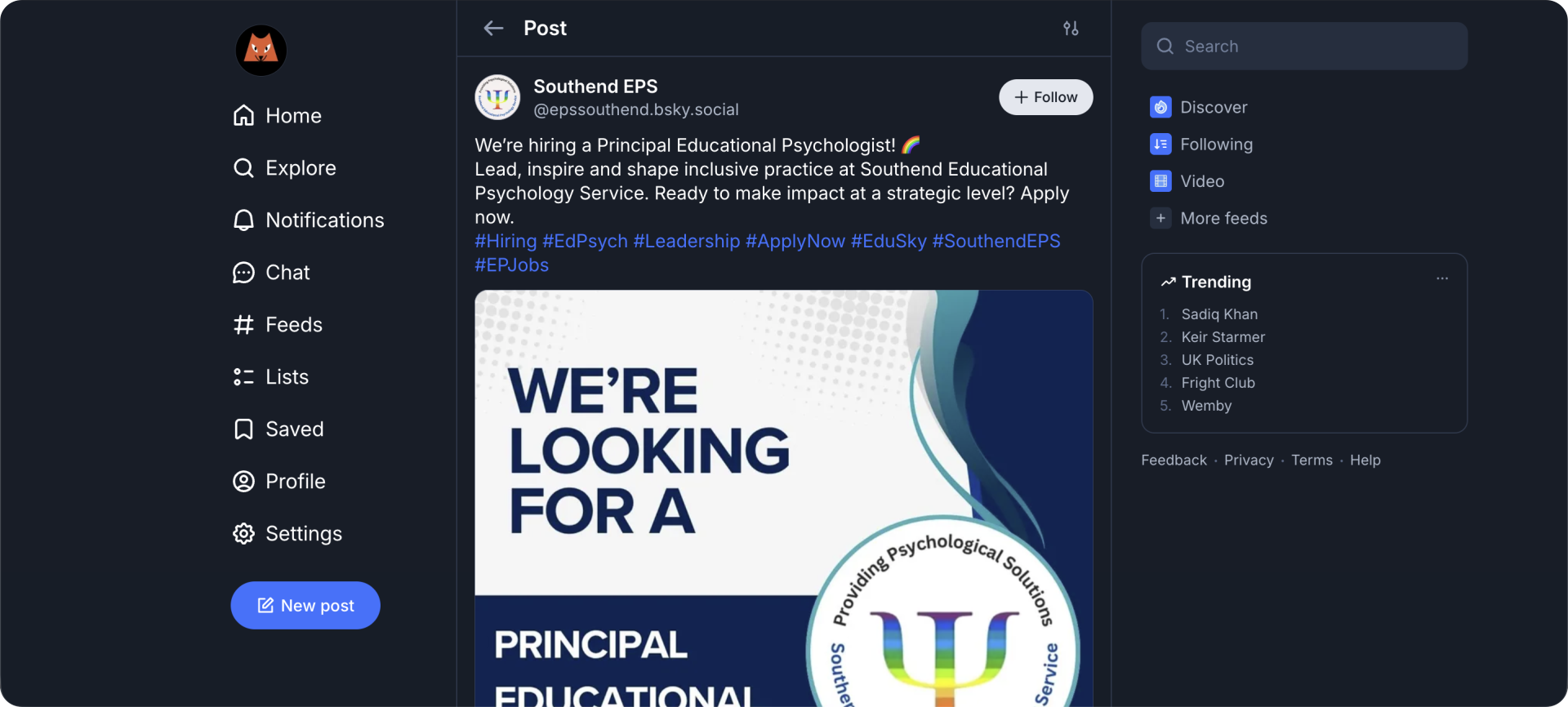
BlueSky has become a destination for direct-from-founder posts under tags like #hiring, #jobs, and discipline-specific tags like #designjobs or #remotework. The posts are short, the URLs are real, the contact paths are direct. The platform has no central job board feature; the hiring layer exists as a behavior, not a feature, which is exactly why aggregators don’t model it.
Public Telegram channels carry sector-specific and regional postings — eastern European tech recruiters, NGO networks, design communities. The channel format is hostile to scraping by design, but a careful observer can subscribe and pull the public feed without violating any terms.
Lobsters runs a quarterly Who’s Hiring thread modeled on Hacker News but smaller and tighter. Around twelve top-level postings per quarter, every poster the company employee themselves, every post following the same template — Company, Position, Stack, Compensation, Contact. The cadence is quarterly, the volume is sparse, but the signal density is high and the European representation is unusually strong.
Reddit’s hiring subreddits — r/forhire, r/jobbit, r/MachineLearningJobs, r/PythonJobs, r/techjobs, r/remotejs — carry hundreds of postings a week. Several of these mix hiring posts (employer offering) with for-hire posts (freelancer self-promoting); the flair field separates them. The volume is large enough that filtering matters more than discovery — the work is separating real signal from candidate self-promotion and aggregator content reposted from elsewhere.
Mastodon carries hiring posts through hashtags rather than dedicated job features. #GetFediHired, #Hiring, and a few niche tags like #HachyJobs federate across instances; a post made on one server reaches readers on any server that follows the tag. Founders, engineers, and small companies use it heavily. The federation property makes the hashtag layer self-aggregating — pick one large instance, scan the hashtag timeline, see the network.
What these channels have in common, beyond being uncrawled, is shape: lower-volume than aggregators, higher-trust posters, less crowded applicant pools, faster from posting to first response. They are the modern shape of what the hidden job market was always supposed to be — opportunities that move faster than the public market sees them.
The breadth nobody can follow
The other half is structural. The visible job market in Europe is not one market; it is dozens, each with its own regional or sectoral cut.
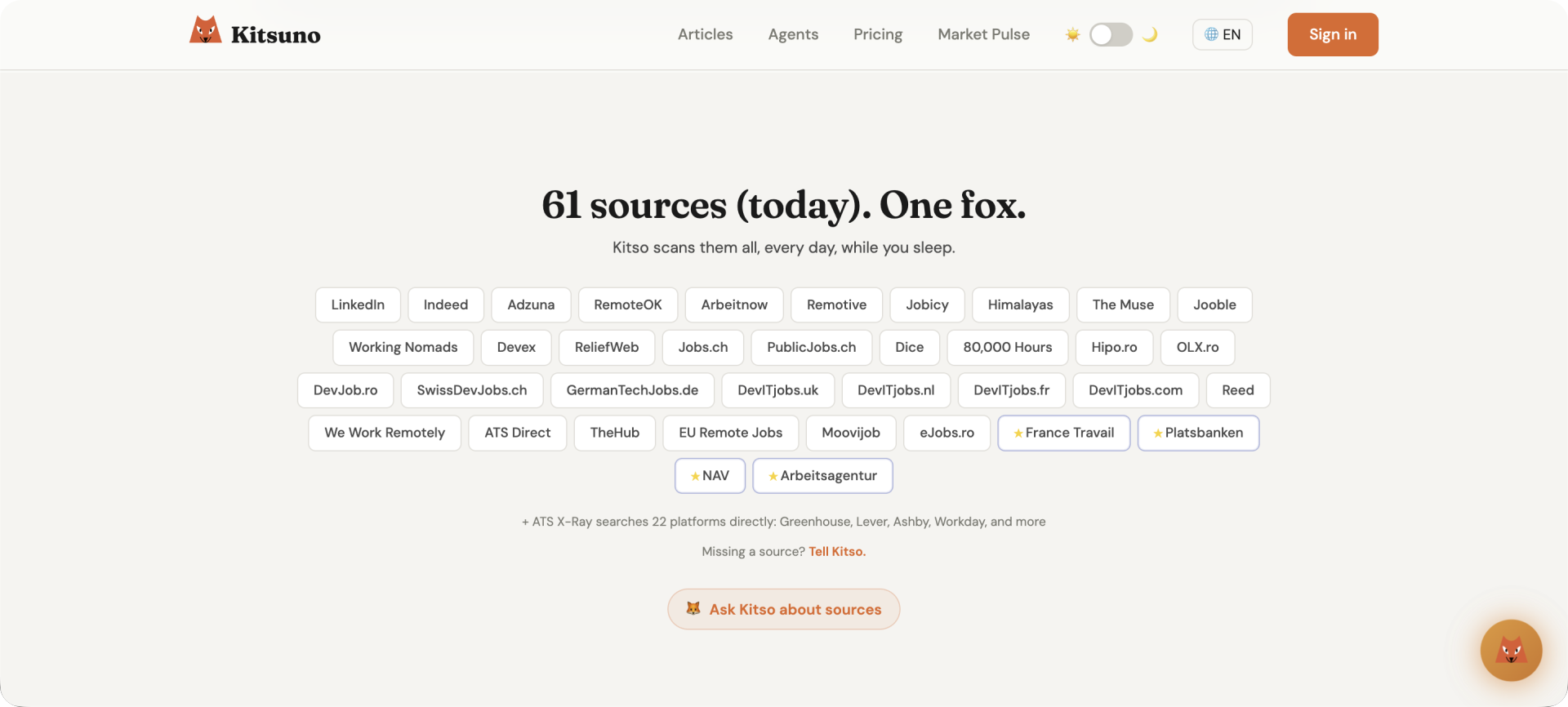
A serious Swiss search needs jobs.ch for the broad commercial market, publicjobs.ch for cantonal and federal public sector, and SwissDevJobs for technical roles. A German search needs Arbeitsagentur for the official federal feed, arbeitnow for remote-friendly tech, GermanTechJobs for the specialized layer. France needs France Travail and devITjobs.fr. Romania needs devjob.ro for tech and the wider classifieds layer of OLX. The Nordics need NAV in Norway and Platsbanken in Sweden. International development needs ReliefWeb. The remote-first layer needs RemoteOK, Remotive, Himalayas, Jobicy, Working Nomads, and WeWorkRemotely. The aggregator layer — LinkedIn, Indeed, Adzuna, Jooble, Reed, The Muse, Dice — sits on top.
Below all of that, the ATS platforms — Greenhouse, Lever, Ashby, Workday, Recruitee, SmartRecruiters — host the direct corporate career pages of hundreds of European employers, often days before a role surfaces on LinkedIn at all.
This is not a comprehensive list. It is the shape of the surface, and it is intentionally illustrative: any one job seeker working seriously across Europe would benefit from monitoring most of these, but in practice almost nobody does. The cost of attention exceeds the budget. So a candidate searches LinkedIn and Indeed thoroughly, and treats the rest as a long tail they will get to later. Later does not come.
One pool, many channels
Kitsuno’s response to both halves is architectural: a single cross-profile pool, continuously fed by broad observer scans, that every profile can match against.
Internally this pool is called Hidden Market. The naming was deliberate. It is the layer most aggregators don’t expose — the gonzo channels and the long-tail regional sources merged into one structured stream that every user gains access to, regardless of which sources they have individually enabled on their own profile.
The pool is not the same thing as a profile’s regular Scanner crawl. The Scanner crawls the named sources you have toggled on in Profile Settings; the Hidden Market runs alongside, on a broader surface, on the platform’s schedule. It reaches you in two ways: as a continuous inflow of pre-scored matches for Pro users, and as a browsable pool any user can search and pick from on demand.
Two paths in
There are two ways into the pool.
The first is auto-match, a continuous inflow on the paid tiers. Every hour, a matcher cross-references the newest entries in the Hidden Market against your profile’s search keywords. On Pro, strong matches are automatically scored against your profile, and the ones that clear your threshold land in your pipeline — badged with a Hidden Market pill so you can see at a glance which entries came from this layer rather than from your regular Scanner crawl. The matcher does the watching, scoring is automatic, and the pill makes the path transparent. The decision to act on each match is still yours; that is where the platform stops doing things on your behalf.
The free Kit tier does not get auto-match into pipeline. For Kit, the Hidden Market is reachable through Manual Picks (five per week). Pro (unlimited Manual Picks plus auto-match) opens the continuous inflow, and so do the 7 days of Pro that start with your first hunt.
The second is Manual Picks. From the search bar at the top of your desk, browse the pool directly.
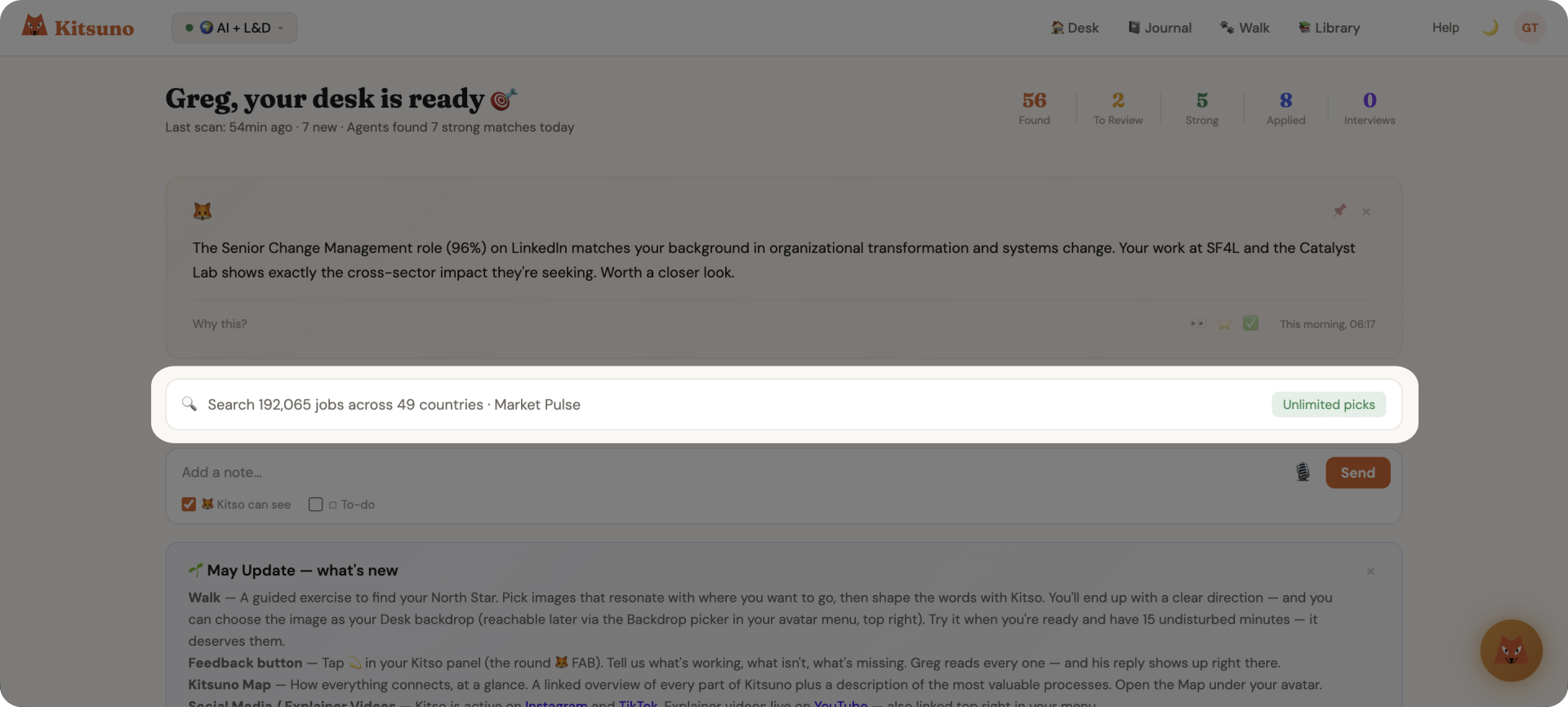
Filter by country, work mode (remote / hybrid / on-site), employment type (full-time, contract, freelance), and posting age. Click + Score on any role that catches your eye. Full profile scoring runs against it, and the job lands in your pipeline within a minute. This is the path that turns the breadth into something you can actually shop.

Each path serves a different mode. Auto-match is what runs while you work on something else — a steady inflow of pre-scored matches you review on your schedule. Manual Picks is what runs when you have an hour to actively explore — a way to walk through the whole inventory deliberately, on your own terms.
The signal breadth gives back
There is a second-order effect of watching the whole surface continuously, and it is the part nobody else does.
When Kitsuno’s observer pulls from dozens of sources across Europe simultaneously and routes everything through one structured pipeline, the platform learns the shape of the market — and learns it specifically against your profile’s search. Which sources are running hot in your field. Which keywords appear repeatedly in the postings that fit your evidence but aren’t yet in your keyword list. Which adjacent skills show up in roles you keep matching against. Which sources you have enabled have gone quiet and may have changed their feed format. Which sources are producing strong matches for users with profiles similar to yours but aren’t on your enabled list yet.
That intelligence comes back to you — but separately from the jobs themselves. The auto-match brings you jobs. Kitso’s Field Notes bring you the strategic read of your search. Periodic, profile-specific notes that read like advice from a careful colleague: jobs.ch has more roles in your field than your current source mix is reaching — consider enabling it. Your profile is missing a keyword that appears across a meaningful share of your strong matches. The Hidden Market has been quiet on your keyword set this week — try broadening it. A source you have enabled has stopped producing rows; the feed may have changed.
The Field Notes are not job listings, and they don’t ask you to apply to anything. They are coaching about the search itself, derived from what the platform has been watching on your behalf at scale. Depending on your tier, the right response might be to refine your keywords, to broaden your sources, or to add new ones you hadn’t considered. This is the breadth compound that serves you — not as a louder inflow, but as smarter search.
Watching one source teaches you about that source. Watching a wide surface teaches you about the market. The signal is the dividend on the breadth.
Your keywords compound
A keyword strategy tuned for one source has limited value. The same strategy tuned and applied across thirty sources is leverage.
The same keyword list that filters your LinkedIn crawl drives the Hidden Market auto-match. The same exclusions you set to keep junior-level roles out of your pipeline also keep them out of your Manual Picks browsing. A profile keyword that distinguishes L&D Director from L&D Consultant doesn’t just filter one aggregator; it filters everything Kitsuno watches on your behalf.
This is the practical answer to the question every job seeker eventually asks: am I using the right keywords? The answer is empirical, and the platform has the data. The Source Optimization Signal looks at the words appearing in the postings you have matched strongly against, compares them with what is in your current keyword list, and surfaces what’s missing. Keyword tuning stops being guesswork.
What you don’t have to do
The architectural inversion is also the user-facing one. You do not subscribe to a Hacker News thread on a calendar reminder. You do not watch a BlueSky tag. You do not maintain a spreadsheet of regional boards by country. You do not learn which ATS platform Stripe uses, or Wolt, or N26.
You do tune your keywords. You do enable the named sources that match your sector. You do, occasionally, click Manual Picks and walk through the pool with the filter set to your country and the posting age set to last 24 hours. The infrastructure work — the per-channel scrapers, the rate limits, the schema drift, the regional formats, the language coverage — sits on the platform side. The work you keep is the work that requires your judgment: what you are looking for, and whether what surfaced is worth pursuing.
The advantage that compounds
The compounding is the whole point.
Earlier reach: jobs from informal channels reach you before they would appear on aggregators, if they ever do. Less-crowded applicant pools: roles posted in smaller venues attract smaller applicant counts; your application carries more weight by default. Broader coverage: every source archetype across Europe is watched continuously on your behalf without per-source maintenance from you. Intelligence: the breadth feeds back signals about which sources, keywords, and skills are running hot for your specific profile. Transparency: every match in your pipeline traces back to the source it came from, by name, with a back-link to the original posting.
The conventional answer to the hidden job market is spend more energy on the market. The Kitsuno answer is the opposite: spend less energy on monitoring, more energy on judgment. The infrastructure does the watching. You do the deciding.
Two more directions
Beyond the Hidden Market, two extensions of the same principle.
Bring your own job. If you found a role anywhere Kitsuno doesn’t reach — a friend’s referral, a recruiter email, a posting on a site outside the pool, a PDF attached to a message — paste the text, the URL, or the PDF into Kitsuno and let the platform analyze it. Same Extractor, same Scorer, same Writer. The result lives in your pipeline, scored against your profile, ready to act on, stored alongside everything else. Your judgment about what’s worth analyzing carries equal weight to the platform’s judgment about what to surface.
Turn the picture around. The platform is built to bring opportunities to you, but it also runs the other direction. With the Portfolio function, your Library becomes a public surface that recruiters and hiring managers can discover and engage with on their terms — visible to recruiters only, or fully public, your choice. Configurable, exportable, deletable in one action. The hidden market is about reach. The Portfolio is about being reachable.
Start a free profile →
Free Kit tier. Two general sources, five Manual Picks per week into the Hidden Market, full scoring, full Kitso chat. No card required.
ManifestoWhat is a Living Career Portfolio? →
The architectural argument for a structured, growing, owned record of your career evidence — the layer the matcher reads from when scoring against you.
SourcesOpen-source EU job sources →
The directory of public sources Kitsuno crawls in production — the named layer beneath the Hidden Market pool. Dual-licensed for the broader ecosystem.
PrinciplesWhy Kitsuno exists →
The ten principles behind every product decision — including the commitment to surface, not auto-execute, that shapes how the Hidden Market reaches you.
MethodologyHow we measure →
Specialized AI agents, four scoring rubrics, fourteen-check validator. The pipeline that reads from your Library and turns every Hidden Market match into a score.
Founder essayStop Being a Meat-Puppet →
The philosophical case behind the no-auto-execute position. Companion thinking on user agency — the principle the Hidden Market matcher honors. On Medium.
Published 11 May 2026. No affiliate links. No sponsored placements.